


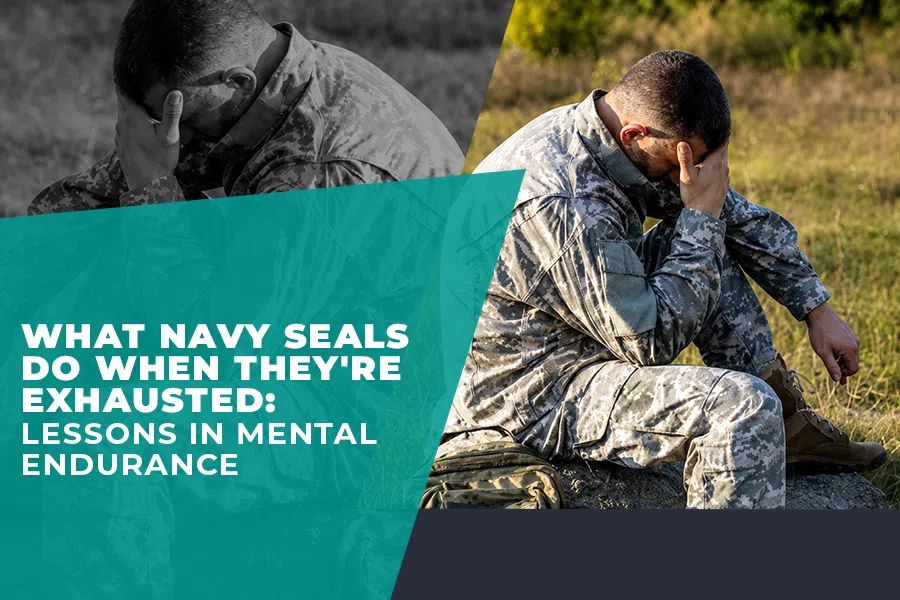
Most of what gets called Navy SEALs mental endurance online is basically just… not quitting when your brain is begging you to. That’s it. No secret formula, no magic breathing pattern that flips a switch in your skull and suddenly you’re fine. I wish there was one. I went down a rabbit hole on this a while back, mostly because I was tired all the time for boring, ordinary reasons – bad sleep, too much screen time, the usual stuff – and got curious what people who get pushed to actual extremes do differently.
Turns out the real version of this isn’t really about being fearless or having some iron will nobody else has. It’s more about managing your attention when every part of you wants to lie down on the floor and stay there. Which is kind of a letdown to hear, honestly. You want there to be a trick. There isn’t really one, just a handful of small, repeatable habits that quietly add up.
The tired brain lies to you first
Here’s the thing nobody really explains well – your body usually has more left in it than your brain is willing to admit. There’s this idea floating around, you’ve probably heard some version of it, that people quit somewhere around 40% of their actual capacity, because the brain starts sending “stop” signals long before the body is anywhere close to done. Whether that exact number holds up under a microscope, I have no idea, I’m not a physiologist. But the general shape of it lines up with most of what I’ve read.
There’s this assumption that Navy SEALs’ mental endurance is some superhuman gene thing, like they were born missing the part of the brain that complains. They weren’t. The complaining part is still very much there. They’ve just had a lot of practice arguing with it and winning. Sometimes losing too, probably – we just don’t hear about those particular days.

Breathing like it’s the only knob you can turn
When everything’s going wrong and you’re exhausted and your hands won’t stop shaking, there isn’t a lot you can actually control in the moment. Your breath is one of the few things that’s still yours. Box breathing shows up in basically every breakdown of Navy SEALs’ mental endurance you’ll come across, and I get why – four seconds in, hold for four, out for four, hold for four, repeat until your heart rate stops doing whatever frantic thing it was doing a minute ago.
Focus under stress, from what I’ve read, has way more to do with this kind of breathing than with willpower, which sounds almost too simple. I was skeptical for a while. Like, that’s it, just breathe slower? But there’s something about slowing the exhale that tells your nervous system the emergency is smaller than it feels in the moment. It doesn’t make the exhaustion disappear. It just makes it manageable for a few more minutes.
Shrinking the goal until it’s almost insulting
This gets repeated a lot, but I think people underestimate how literal it actually is. During something like Hell Week, the goal isn’t “finish Hell Week.” No tired brain can hold onto something that huge while freezing and sleep-deprived. The goal shrinks down to something absurdly small instead. Get to the next meal. Get through this one evolution. Get to the next time someone blows a whistle. That’s the entire horizon, nothing past it.
Honestly, this might be the actual core of Navy SEALs’ mental endurance – shrinking the world down to something so small it stops feeling impossible. Most endurance strategies people talk about online fall apart the second real exhaustion hits, mostly because they’re built around big, motivating goals, and big goals are exactly what an exhausted brain can’t process. Small, dumb, almost embarrassingly small goals tend to work better.
Sleep deprivation does weirder things than just making you tired
People assume being sleep-deprived just means you’re groggy and want a nap. It’s stranger than that. Hell Week pushes people into actual hallucinations sometimes – seeing things that aren’t there, losing track of time, forgetting basic words mid-sentence. There’s actual research on sleep deprivation performance and reaction times that’s a little unsettling if you sit with it too long, because the decline doesn’t happen gradually, it sort of falls off a cliff past a certain point.
Sleep deprivation research keeps getting dragged into conversations about Navy SEALs’ mental endurance, and for good reason – Hell Week is basically a five-day experiment in cognitive collapse, and somehow most people who start it actually finish it. Not because their brains stopped being affected. They were affected the entire time. They just kept functioning anyway, badly, slowly, but functioning. Cognitive resilience seems to be a lot more trainable than people assume, not some fixed trait you either have or don’t.
The buddy next to you is basically a backup battery
Nobody really talks about this part of Navy SEALs’ mental endurance enough, but having someone next to you who also isn’t allowed to quit changes the math completely. It’s not really about pep talks or motivational speeches, more like – you borrow their willpower when yours runs dry, and they borrow yours later when it’s their turn to run dry. SEAL training is built around swim buddies and boat crews specifically because isolated exhaustion breaks people faster than shared exhaustion ever does.
This is fatigue management, not some secret weapon, and it’s kind of underrated outside military stuff. Civilians tend to try pushing through hard things completely alone, like asking for backup is some kind of cheating. It isn’t. It’s just the smarter way to do it.
Toughness isn’t really a personality trait
I used to think toughness was something you either had or didn’t, like height. Apparently that’s mostly wrong. Mental toughness gets thrown around so much it’s basically lost its meaning at this point, but in this context it means something pretty specific – a rehearsed response to discomfort, practiced over and over until it stops feeling like a crisis every single time.
So when people say Navy SEALs’ mental endurance is just toughness, I’d push back on that a little. It’s less raw grit and more a reflex that’s been drilled so many times it doesn’t need conscious effort anymore. Which actually makes it more learnable than the “iron will” version, not less. You’re not born with a reflex. You build one, slowly, the boring way.
Wide awake at 3 am when nothing in you wants to be
Staying alert after 18 or 20 hours without sleep is less about caffeine than people assume, though caffeine obviously helps in the short term. It’s also about medications like Modasmart 400 mg that can help you stay awake when it’s quite important. It’s more about giving your brain tiny jobs to do – counting steps, checking gear, running through a basic checklist out loud even if nobody’s listening. Idle, exhausted brains drift toward sleep pretty fast. Busy, exhausted brains, even doing something small and kind of pointless, tend to stay online a bit longer.
Performance under pressure isn’t really about adrenaline either, weirdly enough – it’s about routine, the same checklist done the same way every time so your tired brain doesn’t have to make brand new decisions. New decisions cost energy you don’t have left at 3 am. Old, practiced ones barely cost anything at all. Most of the Navy SEALs’ mental endurance stuff you’ll read about boils down to exactly this, practiced responses instead of fresh decisions, over and over until it’s basically automatic.
Conclusion
Navy SEALs’ mental endurance ideas show up in exam rooms and hospital shifts and deadline weeks just as much as in training pools, probably more often honestly, since most of us aren’t doing Hell Week but plenty of us are running on five hours of sleep trying to finish something that actually matters. Box breathing before a stressful meeting. Shrinking a huge project down to “just this next paragraph.” Telling someone you’re struggling instead of white-knuckling it solo and pretending you’re fine.
Nobody’s chasing peak mental performance during finals week or a double shift at a hospital. You’re just trying to get through the next hour without falling apart completely, and that’s fine, that’s honestly the realistic goal most days for most people. The SEAL stuff isn’t really about being superhuman underneath all of it. It’s about staying functional when you’d really, really rather not be.
Anyway, that’s most of what I’ve got on Navy SEALs’ mental endurance. It’s less mystical than people make it sound, and somehow still harder to actually do than it sounds on paper. Knowing the breathing pattern doesn’t mean you’ll remember to use it at 2am when everything’s falling apart around you. You just have to practice it enough times that it stops being a decision and becomes the thing you do automatically, the same way they did.
FAQs
1. Can Modasmart 400 mg be used by Navy SEALs’?
Modasmart 400 mg can be used by Navy SEALs’ to endure severe sleep deprivation.
2. What’s the fastest way to calm down when you’re exhausted and stressed?
Slow, controlled breathing – something like four seconds in, hold, four seconds out – tends to work faster than people expect.
3. Do Navy SEALs actually get any sleep during Hell Week?
Very little. Usually just a few hours total across the entire week, sometimes even less.
4. Why does breaking goals into tiny pieces actually help?
Big goals overwhelm a tired brain. Small ones usually feel light and something that can be achieved, so you need to keep moving instead of freezing up.