


There’s a gap between when something starts going wrong in the brain and when anyone actually notices. Family members don’t catch it. Physicians often don’t catch it either, not in early visits anyway. And that gap is basically where brain networks quietly start reorganizing themselves, years before memory problems show up on a test.
Most people think cognitive decline is sudden. It isn’t, really. It’s slow, and it’s happening at a network level long before it’s happening at a “forgot where I parked” level.
Related: 13 Facts of Why We Lose Our Memory
The brain doesn’t fail all at once, it shifts
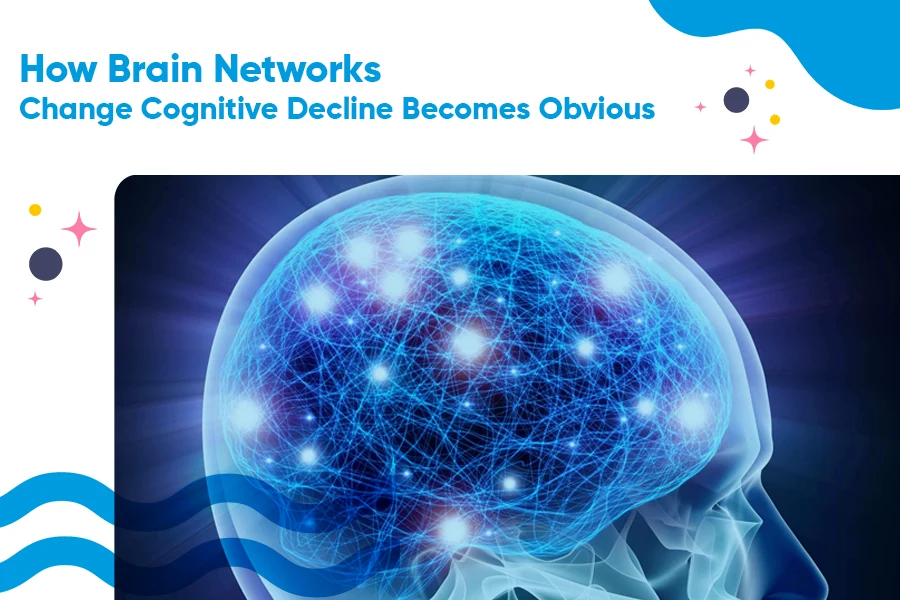
Brain networks aren’t single regions doing single jobs. That old idea is mostly outdated now. Instead, you’ve got large-scale systems like the hippocampus talking to prefrontal areas, parietal regions talking back, everything looped together in ways that shift depending on what you’re doing. Rest state fMRI studies have picked up on this for years now, showing that even when someone is just lying still in a scanner, not doing any task, their brain networks are active, communicating and syncing up in patterns.
In early Alzheimer’s changes, some of that syncing starts breaking down before anyone would call it “decline.” Connectivity gets patchy. Some networks work harder to do what they used to do effortlessly. Others go quiet in odd ways.
It’s not damaged exactly. Or not only damage. It’s more like the wiring starts taking longer routes to get the same signal across.
Default mode network
If there’s one network that keeps showing up in this research, it’s the default mode network. It’s active during daydreaming, mind-wandering, memory retrieval, that background hum of thinking about nothing in particular. Turns out this network is one of the earliest to show disruption in preclinical Alzheimer’s disease – meaning before any diagnosis, before any real symptoms, sometimes a decade before.
Some studies show reduced connectivity within the default mode network in people who are cognitively normal but carry amyloid markers. Other studies show something almost the opposite which is hyperconnectivity, like the brain is compensating, working overtime to keep things stable. Both patterns show up depending on disease stage, which honestly makes this messier to interpret than most articles make it sound.
This is part of why cognitive decline markers based purely on symptoms are so late to the game. The brain network changes come first. The symptoms are basically the last chapter, not the first sign.
Hippocampal connectivity aging
People assume hippocampal shrinkage is the main story in aging and Alzheimer’s risk. It’s part of it, sure. But hippocampal connectivity aging (how well the hippocampus talks to the rest of the brain network) seems to matter just as much, maybe more in early stages.
A hippocampus that’s structurally fine can still be poorly connected. The wiring around it weakens before the region itself shrinks in any measurable way. So someone could have a perfectly normal-looking hippocampus on a structural scan and still show weaker network connectivity to it. That’s a subtle distinction that gets lost a lot in general health articles about brain aging.
Brain network aging isn’t just about losing neurons. It’s about losing the efficiency of communication between regions. Different problem, similar outcome eventually.
Subjective cognitive decline
Subjective cognitive decline is when someone notices, themselves, that their memory or thinking feels “off,” but every standard cognitive test comes back normal. For a long time this was dismissed, treated as anxiety or normal aging worry.
Turns out functional network reorganization can already be underway during this stage. Not always, not for everyone reporting subjective decline; plenty of that is genuinely just stress or normal variation but a meaningful chunk of people with subjective cognitive decline do show altered brain networks on neuroimaging, particularly involving the default mode network and networks tied to attention.
So the person isn’t imagining it, in some cases. Their brain is already shifting how it’s organized, just not enough yet to fail a test.
Functional network reorganization: the compensation phase
There’s a phase that a lot of the neuroimaging cognitive aging literature calls compensation, where the brain starts pulling in extra resources to keep performance stable. Other brain networks like the frontal regions especially start getting recruited more, doing jobs that used to belong more exclusively to memory-related circuits.
This is actually why some people can have real Alzheimer’s-related brain network changes going on and still perform fine on cognitive tests for years. Their brain networks are reorganizing around the damage, redistributing the workload. It’s kind of remarkable actually, how long that compensation can hold up.
But eventually the compensating networks get overloaded too. And that’s usually around when symptoms start becoming noticeable to family, friends, the person themselves. Not because the damage suddenly increased, necessarily just because the compensating brain networks ran out of room to keep covering.
What resting state fMRI is picking up on?
Worth pausing here because resting state fMRI is doing a lot of the heavy lifting in this whole field of research, and it’s honestly a bit of an odd tool if you think about it. No task, no stimulus, just watching for spontaneous fluctuations in blood oxygen levels while someone rests. From that noise, researchers extract patterns of synchronized activity across brain networks.
It sounds almost too simple. But the data from this method has become central to how preclinical Alzheimer’s disease research identifies at-risk individuals before symptoms. Weakened connectivity in memory-related networks, unusual hyperconnectivity in others, disrupted communication between hub regions show up on resting-state fMRI well before cognitive tests would flag anything.
Not perfect though. Individual variability is huge. One scan on one day for one person doesn’t tell you much reliably. It’s really only useful in aggregate, across populations, over repeated measures. That limitation gets glossed over a lot in pop-science coverage of this stuff.
Why does “normal” cognitive testing not catch these early signs?
Standard cognitive tests are built to catch decline once it’s already affecting daily function in a measurable way. They’re not sensitive to the earlier stage where brain networks are reorganizing but performance is still holding.
This creates this weird disconnect that someone can ace a cognition test, genuinely, honestly ace it, while their brain networks are already showing the kind of connectivity patterns associated with early Alzheimer’s changes. Not everyone with these patterns progresses to dementia either, which complicates the whole predictive value question even more.
Researchers are trying to find better markers, ones sensitive enough to flag risk before symptoms but specific enough not to cause false alarms. That balance hasn’t really been struck yet, not consistently, not across different populations and different risk profiles.
Related: Stress Impacts Sleep Quality and Cognitive Function
Does this mean brain network changes are inevitable with age?
Not exactly-some degree of brain network aging is basically universal, it happens to almost everyone. But the specific pattern, the specific speed, the specific networks involved seem to vary a lot depending on genetics, vascular health, lifestyle factors, and probably a bunch of things researchers haven’t fully mapped yet.
Aging brain networks aren’t automatically pathological. Some reorganization is just normal aging, adaptive even. The tricky part researchers are still working through is figuring out where normal aging ends and preclinical disease begins, because right now those lines blur more than most explanations admit.
FAQs
-
Can brain network changes be detected before memory loss starts?
Yes, often years before, mainly through resting state fMRI studies looking at connectivity patterns.
-
Is the default mode network the main one affected in early Alzheimer’s?
It’s one of the earliest and most studied, though other networks are involved too.
-
Does subjective cognitive decline always mean something is wrong?
No, not always-but some people with it do show measurable brain network changes.
-
Are brain network changes with age always a bad sign?
Not necessarily. Some reorganization is a normal, even adaptive part of aging.
-
Can lifestyle affect brain network aging?
Likely yes, though research on exact effects is still developing and not fully settled.