


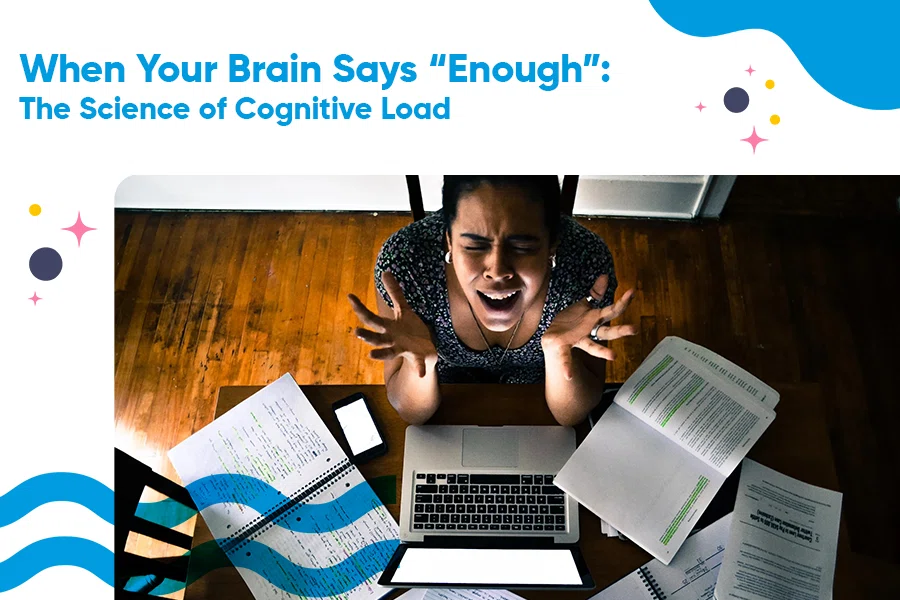
Imagine you’re in your office with fourteen tabs open, a phone buzzing against the desk, a colleague asking something “quick,” and then a perfectly ordinary email stops making sense. The same sentence gets read three times and nothing sticks. It feels like a personal failing, but the research points somewhere less dramatic: the brain has only so much room for active thinking, and that room got crowded. Psychologists call the demand placed on that room cognitive load, and it explains a surprising amount of everyday frustration.
What is Cognitive Load?
The idea comes largely from John Sweller, an educational psychologist who developed cognitive load theory in the late 1980s. He was studying how students learn, and why some worked examples helped while others just made people stare at the page. The rough version of the theory is that learning and problem-solving draw on a small, limited pool of mental resources. When a task asks for more than the pool holds, performance drops. Not always gradually, either. Sometimes it just falls off a ledge.
Other fields use different words for something close to the same thing. In aviation and ergonomics research the usual term is mental workload, and there are actual instruments for measuring it. The NASA Task Load Index, for one, asks operators to rate how demanding a task felt across several dimensions. Pupil size is another proxy, since pupils tend to dilate a little when a task gets harder. Slightly different vocabulary, same worry: how much is being asked of one head at one time.
“Mental load” shows up in everyday conversation too, usually about household management, the invisible tracking of who needs what and when. That’s a social-science cousin of the same idea, and it isn’t quite what Sweller meant, but the overlap is hard to ignore.
Working Memory and Its Strange Little Limits
Everything here hinges on working memory, the mental workspace where information is held and manipulated for a few seconds. Dialling a phone number someone just read out. Following a sentence long enough to reach its verb. Doing arithmetic without paper. Baddeley and Hitch proposed their well-known model of it in the 1970s, with separate components for verbal material, visual material, and a kind of central controller that allocates attention between them.
George Miller’s famous 1956 paper put it at around seven items, plus or minus two, and that figure got repeated in textbooks for decades. Later work, especially by Nelson Cowan, argued the real number is closer to four chunks when people can’t rehearse or group things cleverly. Four. That’s tiny when considered against the pile of things a normal workday throws at someone.
The word “chunk” matters, though. Experts don’t have bigger working memories, as far as anyone can tell. They have better chunks. A chess master sees a board position as a few meaningful patterns where a beginner sees 25 separate pieces. So the same cognitive processing demand can feel crushing to one person and trivial to another, depending on what’s already stored in long-term memory. That’s a big part of why a task can be “easy” for somebody and miserable for somebody else without either person being unintelligent.
Types of Cognitive Load
Sweller’s framework splits cognitive load into three types, and this is the textbook bit, so it gets a little tidier here than real life does.
- Intrinsic load
It is the difficulty built into the material itself. Adding two plus two has low intrinsic load. Interpreting a contract clause with four nested conditions has a lot. It depends on how many elements have to be held in mind at once and how tangled they are with each other.
- Extraneous load
It’s the demand created by how information is presented rather than by the information itself: a confusing slide, instructions split across two pages, a form that asks for the same detail three times. This is the type designers and teachers are supposed to shrink, because it adds effort and gives nothing back.
- Germane load
It is the effort that goes into building understanding, forming those chunks and connecting new material to old. It’s the “good” kind, in theory. Sweller himself has reworked how this category fits into the theory over the years, and some researchers argue it’s hard to separate from intrinsic load in practice. So it’s probably better to treat it as a useful idea rather than a clean box.
The practical upshot is that the three add together. A hard topic (high intrinsic) delivered badly (high extraneous) leaves almost nothing for actual learning. Trim the extraneous part and suddenly the same hard topic is workable. Cognitive load is about that sum, not any single piece.
When the pile tips over: Cognitive overload
Cognitive overload is what happens when the sum exceeds capacity. The symptoms are familiar. Reading without absorbing. Making silly errors on simple things. Irritability that seems out of proportion. A strange urge to just close the laptop and look out of a window.
Part of what’s going on is that the prefrontal cortex, which supports a lot of executive control, gets stretched, and the brain starts defaulting to whatever is easiest or most habitual. A well-cited 1999 study by Baba Shiv and Alexander Fedorikhin gave participants either a two-digit or a seven-digit number to memorise, then offered a choice between fruit salad and chocolate cake. Those holding the longer number picked cake more often. Nothing dramatic, just self-control quietly losing out when working memory was busy. It’s a small experiment, though it keeps getting cited because the pattern is so relatable.
Related: Stress Impacts Sleep Quality and Cognitive Function
Too much stuff, too fast
Information overload is the modern cousin. The volume of messages, notifications, feeds and updates is large enough that information processing starts to feel like a job in itself, and the sorting takes more effort than the actual thinking.
Attention span is where people tend to say things that sound more certain than the evidence. The line about humans having a shorter attention span than a goldfish, from a supposed Microsoft report, doesn’t hold up and has been debunked more than once. What does have decent support is narrower: Gloria Mark’s observational research found that the time people spend on a single screen before switching has fallen sharply over the past two decades, to well under a minute in some samples. Whether that reflects a change in the underlying capacity or just a change in habits is, honestly, still debated.
Then there’s attention residue, a term from Sophie Leroy’s work. After switching from one task to another, part of the mind lingers on the first one, particularly if it was unfinished. So each switch leaves a bit of cost behind, and the costs accumulate. A Stanford study from 2009 (Ophir, Nass and Wagner) found heavy media multitaskers did worse on some filtering and task-switching tests, though later replications have been mixed, so it shouldn’t be treated as settled.
Decision fatigue, with a caveat
Decision fatigue is the idea that making lots of choices gradually erodes the quality of later ones. It’s intuitive. By the end of a long day of small calls, a person may go with whatever is easiest, or avoid deciding at all. The famous Israeli parole judge study, in which favourable rulings seemed to drop before breaks and rebound afterwards, was a headline-grabber, but it has been criticised on methodological grounds, and the broader “ego depletion” research behind it has had trouble replicating.
So the careful reading is probably something like this: the exact mechanism is contested, but the experience is real, and there’s reasonable evidence that decision making under heavy demand shifts toward defaults and shortcuts. Whether that’s “depletion” or motivation or boredom, nobody has quite pinned down.
Related: 8 Signs of Decision Fatigue and How To Cope
Brain fog, mental fatigue, and the vague middle
Brain fog isn’t a medical diagnosis. It’s a description, a catch-all for feeling slow, forgetful, unfocused, a bit detached. It shows up with poor sleep, stress, illness, some medications, and long viral recoveries, among other things, which is why it’s worth taking seriously if it lingers and doesn’t lift. A doctor is the right person for that, not a blog.
Mental fatigue, in the research sense, usually refers to the decline that comes with sustained effort on demanding tasks. Studies tracking people over long stretches of cognitive work find slower reactions, more lapses, and changes in brain activity as time on task grows. Rest helps, though not always as completely as people hope, and a lot of “tiredness” turns out to be a mix of boredom and low motivation rather than depleted resources. The line between those is blurry.
Overall cognitive function dips when load stays high for long periods without recovery. That’s not mysterious, but it does get ignored. Mental clarity tends to return after sleep, movement, and time away from screens, and it’s usually quicker than people expect when the pile is actually reduced rather than rearranged.
Related: Brain Fog: Symptoms, Causes, and Treatment Options
Things that seem to shrink the pile
None of this is a system, just what the evidence tends to support. Writing things down externally removes items from working memory, which is the whole reason lists work. Doing one thing at a time reduces switching costs. Breaking big tasks into chunks lowers intrinsic load. Cleaning up how information is presented, fewer tabs, shorter emails, clear instructions, targets extraneous load directly, and that’s usually the cheapest win.
Sleep matters more than almost anything else on the list, which is unglamorous. Short breaks help. So does fewer notifications, though people rarely believe how much until they try it.
There’s a small contradiction worth admitting: some difficulty is good. Struggling a bit with material is how durable learning happens, so the goal isn’t to remove all load. It’s to make sure the load being carried is the useful kind.
Not really a conclusion
The brain saying “enough” isn’t a malfunction. It’s a limit, an ordinary feature of a system with a small workspace trying to handle a big world. Understanding that doesn’t make the limit go away, but it changes what’s reasonable to expect from a Tuesday afternoon.
FAQs
1. What is cognitive load in simple terms?
Cognitive load is the amount of mental effort a task demands from working memory at a given moment.
2. Is cognitive overload the same as burnout?
No. Overload is a temporary condition of receiving too much input. Burnout is a long-term condition of chronic stress.
3. Does multitasking increase mental fatigue?
Often, yes. Switching between tasks adds extra effort, and that cost builds up over a day.
4. How long does it take to recover from brain fog?
It depends on the cause. Sleep-related fog can clear in a day or two, while persistent fog should be checked by a doctor.
5. Can anyone improve their working memory?
Training tends to improve the practised task more than general ability, but better habits and chunking help in daily life.