


Richard, a 45 year old IT professional from Washington, began experiencing frequent forgetfulness, extreme fatigue, and difficulty concentrating at work . At first he thought that it would be a result of tight deadlines and working environment. However, after struggling with his work performance and extreme mood swings, he decided to take a step further and diagnose his symptoms. He underwent a sleep study as suggested by his physician. Soon the results came and the results confirmed that he suffered from Obstructive sleep apnea(OSA). What began as just common symptoms turned into an underlying disease condition that is OSA in IT professionals.
What is OSA in IT professionals?
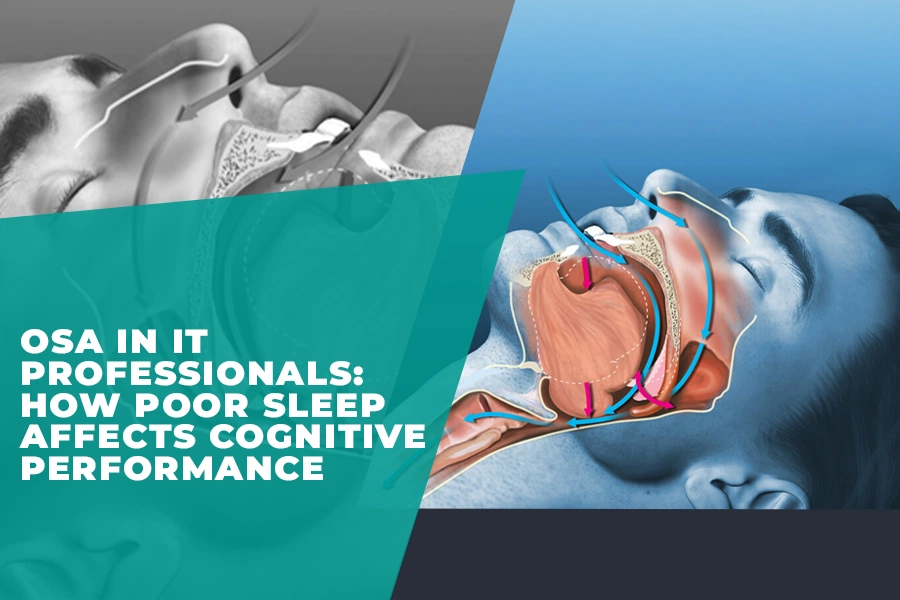
Obstructive Sleep Apnea is a common disorder that relaxes the throat muscles during sleep excessively which causes the airway to block and narrow or collapse the airflow. These breathing disruptions can occur hundreds or thousands of times during the night. Each time the breathing stops, the brain awakes the body to fill the airway as the brain doesn’t get enough supply of oxygen. These micro-awakening often go unnoticed and this is what causes disruption in sleep cycles.

OSA in IT professionals is increasing due to sedentary lifestyles, high stress, poor sleep schedules,excessive screen time, etc. When untreated, OSA can significantly impair obstructive sleep apnea cognitive performance, affecting productivity, concentration, and decision-making at work.
Common symptoms of Obstructive Sleep apnea are:
- Pauses in breathing during sleeping
- Loud snoring
- Excessive daytime sleepiness
- Morning headaches
- Cognitive impairment
- Less concentration and performance issues
As IT professionals already deal with a lot of cognitive stress and demand, all these symptoms can be an add on to the poor cognitive performance.
Why is OSA common in IT professionals?
There are several factors in daily lifestyle that contribute to the tech industry structure. These factors are also a contribution to the increased risk of OSA in IT professionals. Few of the reasons are:
- Work Culture
Several IT professionals like developers, software engineers, analysts, etc sit for 8-12 hours at one position in front of the screen-this leads to weight gain which is one of the major factors for sleep apnea.
- Irregular sleep schedules
Late-night development tasks, tight deadlines, global meetings, extensive workload are all that contribute towards irregular sleep schedules.
- High stress levels
Working on a major project and not feeling stressed might be a superpower very few have. As a normal person, every individual may feel highly stressed under tight deadlines, too much workload, etc. High stress leads to high cortisol levels which directly influences sleep quality.
- Screen Exposure
Working everyday in front of the screens? Do you know what will happen? Too much exposure to blue lights from the monitors and laptop suppresses melatonin, as melatonin gets suppressed it leads to decreased levels of melatonin in the body that makes it difficult to fall asleep.
All these factors when jumbled up become an amazing combination that can lead to sleep disorders.

How does Sleep apnea affect Cognitive performance?
Although its symptoms are quite superficial, the harm that is caused by OSA in IT professionals is beyond manifestations affecting cognitive performance, cognitive functions such as focus, memory, concentration and so on. Understanding this connection is crucial, as untreated OSA can lead to profound and potentially irreversible cognitive impairments.
- Reduced Focus and Attention
Focus & attention is significantly reduced in OSA patients. IT work often requires sustained concentration for coding, debugging, or analyzing data. OSA in IT professionals can lead to frequent lapses in attention which affects the quality of work.
-
Memory Problems
According to research, OSA patients have only 55% accuracy in memory recall whereas normal people have 90% accuracy. Poor sleep disrupts memory consolidation, making it difficult to retain technical information or learn new programming frameworks.
-
Slower Decision-Making
Sleep deprivation affects the prefrontal cortex, which controls reasoning and judgment and leads to slow decision-making ability. Following sleep schedules for OSA in IT professionals is predominantly important.
-
Reduced Problem-Solving Ability
Complex coding challenges require mental clarity. OSA in IT professionals might lead to mental fog and slow analytical thinking.
-
Increased Error Rates
As there is intense fatigue due to poor sleep schedules, it increases the likelihood of coding mistakes, system errors, and poor troubleshooting. Thus with less sleep there are increased errors.
Mechanisms underlying Cognitive Impairment in OSA
1. Hypoxemia and Neuronal Damage
Continuous episodes of apnea lead to low oxygen levels in the blood, causing oxidative stress and injury to the neurons. This process particularly affects the hippocampus, a region crucial for memory formation.
2. Sleep Fragmentation and Neurotransmitter Disturbance
OSA results in frequent awakes during the night which causes disruption in sleep architecture. This fragmentation changes the balance of neurotransmitters required in attention and mood regulation, such as dopamine and serotonin.
3. Neuroinflammation and White Matter Integrity
Chronic intermittent hypoxia and sleep disruption trigger systemic inflammation by affecting the central nervous system. This neuroinflammatory response could cause damage to white matter, alerting communication pathways between different brain regions.
Managing daytime sleepiness in OSA
When thinking of managing daytime sleepiness….what comes to your mind? Is it about taking medication? Many times we neglect such issues and do not take correct measures. Treating the underlying sleep disorder is the most important step. Thus, physicians usually prescribe wakefulness promoting medications to help improve sleep and work productivity. One commonly prescribed medication is Modaheal 100 mg which consists of Modafinil as its active ingredient.
Lifestyle changes for OSA in IT professionals
Medication alone is not the solution to treat OSA in IT professionals. Addressing lifestyle habits is essential for improving the quality of sleep and overall productivity. Sedentary changes that influence are:
- Maintain a consistent sleep schedule
- Limit screen time before bed
- Practice yoga & breathing exercises
- Maintain healthy body weight
- Exercise regularly
- Improve sleep environment
- Incorporate a mediterranean style diet that includes anti-inflammatory foods
- Sleep in a slightly elevated position
- Reduce caffeine and alcohol intake
Conclusion
OSA(Obstructive Sleep Apnea) in IT professionals is an increasing health issue that has been recognized. It influences obstructive sleep apnea cognitive performance and reduces sleep and work productivity. Managing OSA in IT professionals is quite essential be it through lifestyle changes, medications, appropriate treatment plans is essential for maintaining cognitive performance. Medications such as Modaheal 100 mg may help in reducing excessive daytime sleepiness and support mental health. These medications should only be used under medical supervision and as prescribed by the physician. By prioritizing sleep and recognizing early symptoms, OSA in IT professionals can be diagnosed early and the treatment can also give results quicker.
FAQs
- What is OSA in IT professionals?
OSA stands for Obstructive Sleep apnea. So when such a condition occurs in IT professionals it is known as OSA in IT professionals.
2. What are the risk factors of OSA?
Longer working hours, stress conditions, high exposure to blue light, irregular working schedules are the risk factors in OSA.
3. What changes can I inculcate in my diet to support brain health?
Adopting a balanced diet rich in antioxidants, omega-3 fatty acids, and other neuroprotective nutrients supports brain health.
4. Is cognitive decline from sleep apnea reversible?
Yes. Cognitive decline from sleep apnea is highly reversible; it just depends on when the condition is diagnosed.
5. What are the early signs of cognitive impairment due to sleep apnea?
Early signs of cognitive impairment from sleep apnea include excessive daytime sleepiness, severe issues in concentration, trouble focusing,etc.