


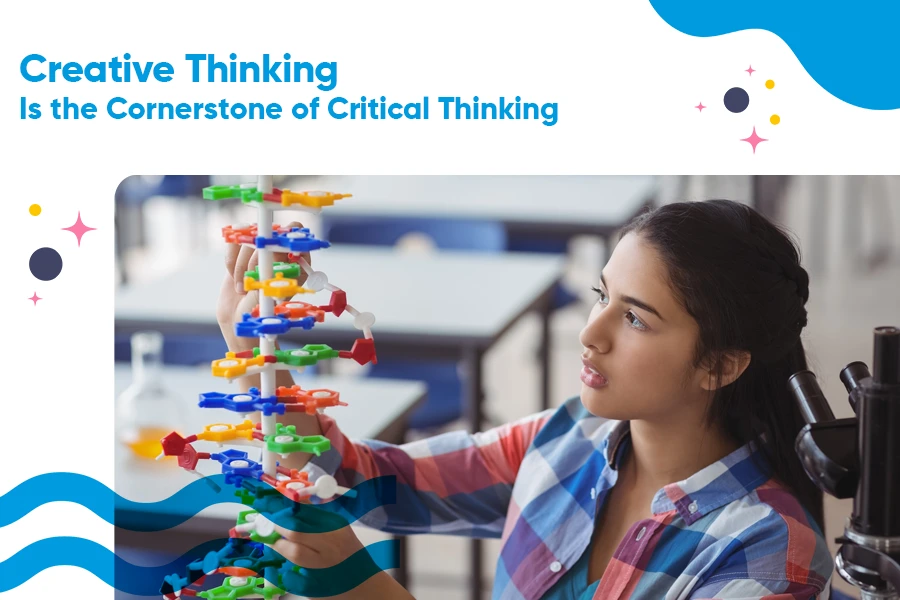
Critical thinking defines the capability that is used to analyze information objectively, ask questions, and arrive at conclusions. A structured process is used to foster creativity. Creative and critical skills are different. But you cannot imagine anything without critical thinking because this challenges you to take the risk of pure mechanical exercise, disconnects you from flexibility, and connects you with real-world issues. Moreover, the greatest paradox is that creative thinking is not necessarily the product of IQ or enlightenment via the proverbial apple falling on your head. It is a matter of regularly training your imagination and practicing your powers of observation and dreaming, big or small.
Where Imagination Meets Reasoning
At first glance, critical thinking and creative thinking are both opposite of each other, but if you associate with both skills, then you realize that the first one is disciplined logic and the other one is free-flowing imagination. They are intertwined deeply in the real world. Critical thinking supplies materials for reasoning and results, whereas creative thinking refines raw materials, fresh concepts, and unconventional possibilities. Strong critical thinking skills generally can not develop imagination, but these help to grow willingness to consider ideas that can fit within thinking patterns.
The Power: Generate New Ideas
Creativity fuels critical thinking by generating new ideas. When you face issues conducting work, you reach for familiar solutions or outcomes instinctively, but normal critical thinking demands more. This requires multiple possibilities before reaching a relevant outcome. Where creative thinking skills become indispensable, it pools various options for evaluation. You can create several plausible approaches to position and compare a situation’s strengths and weaknesses that help you consider the right path to proceed.

Learning to Think Outside Box
The “think outside box” concept underlines the idea that it is important to think genuinely. Traditional thinking relies on established patterns, previous experiences, and familiar models; however, there have been limitations. Creative thinking encourages you to break previous models or patterns and raise questions about their limitations or negative aspects. This willingness reveals solutions or builds new patterns or models that are completely outside familiar boundaries.
Sharpening the Ability to Analyze and Evaluate
Creative thoughts do not replace exact work, but these enhance new ideas. New perspectives are created, and then you analyze and evaluate them by using a discerning eye. Where critical thinking leads to working, testing logically, and identifying potential gaps, evaluation processes work to assess diverse material. A predictable idea offers critical thoughts to a sharp work process, while rich creative ideas set opportunities for real depth.
Strengthening Problem Solving Abilities
The connection between critical thinking and creativity develops strong problem solving abilities. These require the capacity to analyze the challenges, find multiple solutions, and select a relevant solution by combining unrelated ideas into the work. Creative thinking brings flexibility to reframe issues in different ways and deliver solutions in a new way. In this case, critical thinking ensures that solutions are sound logically and feasible practically. Problem solving process becomes reliable and inventive. This helps to remove originality from rigorous imagination.
How Creativity Helps Foster Innovation
Innovation rarely emerges from an analytical process. Individuals or organizations need positive and effective work environments where employees can explore creativity. This helps to foster innovation. It also encourages careful evaluation. Many groundbreaking ideas seem impractical and begin to refine critical thoughts into workability. Thus, it delivers valuable solutions. Critical thinking shapes functional activities. This helps to balance disciplined assessment and imaginative freedom. It allows innovations to flourish in a meaningful way.
The Value of Exploring New Perspectives
It is important to explore new perspectives to improve your creative and critical thinking. It can improve your personal experience, professional training, and cultural aspects. Creative thinking pushes against the tendency of old concepts, unfamiliar viewpoints, and old formulas. For this reason, one person’s creativity is different from another person’s. This exposure enriches critical analysis in various ways to see an issue. This also helps to evaluate an idea when it can be stress-tested against diversified viewpoints as opposed to isolation.
Applying Logical Reasoning to Creative Ideas
Creativity can not drift into ideas without any pattern or structure. For this reason, you need to apply logical reasoning that can be complementary to imaginative thinking. Logical reasoning and diverse perspectives are steps towards testing new ideas’ coherence, feasibility, and consequences. This process transforms raw thoughts into actionable creativity. Logical reasoning acts as a natural complement to critical thinking to ensure that there is no odd imagination. As a consequence, when learned well, logical reasoning has the power to unleash creativity. You need to build enough connections; then you can follow a more direct path to the winning idea.
Building a Mindset That Balances Both
You need to cultivate a mindset with intentional practices. These involve shifting brainstorming freely into more analytical thoughts for testing new ideas rigorously. It seeks to question a long-held assumption and find uncertainty in original ideas. This helps to reduce the level of uncertainty in old ideas and align them to broader imaginative exploration. Over time, this builds a bridge between imaginative exploration and careful evaluation, which becomes a natural rhythm in your mindset.
To Conclude: Bringing Creativity and Critical Thinking Together
From the above analysis, it can be said that critical thinking and creative thinking are separate as per pattern, but you can explore and implement any new idea with critical analysis or thoughts. A strong-minded thinker can move fluidly between rigorous analysis and imaginative exploration. This brings strength in ideas and work processes. Creative thoughts open opportunities to refine something reliable as well as valuable. If you can recognize creative thinking as the true cornerstone of critical thinking, then you can implement any idea in your personal or professional life. But remember, a practical shift can increase complexity based on an individual’s or organization’s approach towards problem-solving, innovation, and decision-making processes.
Related blog: Is there a link between ADHD and Creativity
FAQs
1. Why is creative thinking considered essential to critical thinking?
Creative thinking is considered essential to critical thinking because creative thoughts provide multiple ideas as well as perspectives that help a critical mindset evaluate, refine, and establish in the real world.
2. How can you improve your critical thinking skills through creativity?
You can improve your critical thinking skills through creativity by practicing brainstorming. Avoid judging immediately, explore unfamiliar perspectives, and ask questions regarding works. These help to create distinctive ideas, which increase the strength of critical analysis.
3. What role does thinking outside the box play in problem-solving?
Thinking outside the box plays an important role in problem-solving. This is to break limited patterns, to reveal solutions, and to find new aspects from irrelevant areas.
4. Is creativity linked to high IQ?
Yes, creativity is linked to high IQ. Excellent grades, high IQ scores, and high income suggest the presence of high intelligence, but they do not guarantee its continued successful application. The creative approach explores creative processes and how they are unusual, inventive, and useful through high IQ.
5. How do new perspectives improve decision-making?
New perspectives improve decision-making by managing diverse viewpoints. This allows ideas to be evaluated more thoroughly to expose upcoming assumptions and blind spots. This leads to a better decision-making process.