


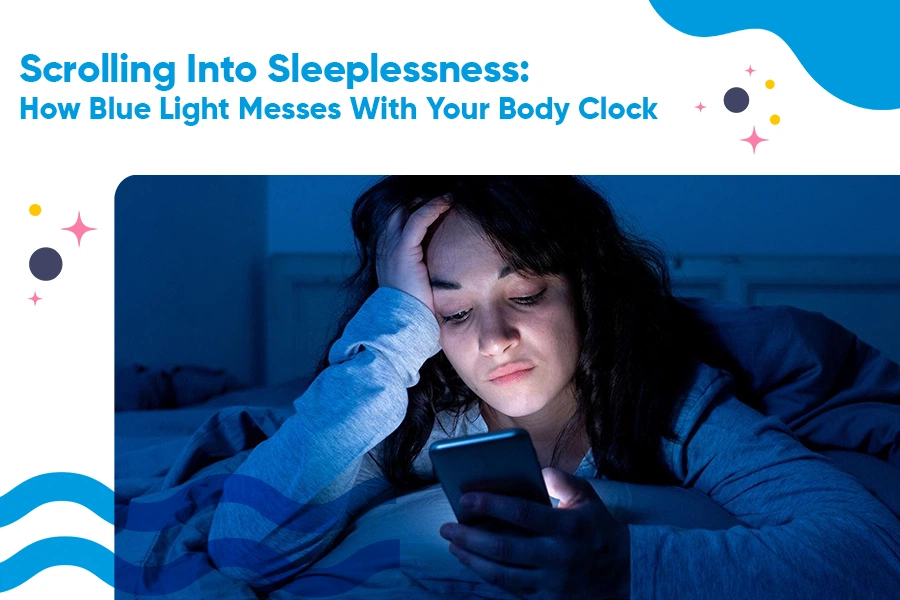
Since a lot of years sleep has been getting a lot of attention, and rightfully so. We need adequate sleep for almost everything, from memory to even processing our own emotions. There are countless online articles telling us about sleep hygiene and how you can optimize your sleep, and a key piece of advice in all of those is putting away our electronic devices.
That sounds like torture to most of us. I mean, what about your TikToks before bedtime? That’s surely a way of relaxing. As much as it feels amazing to shut your brain and just doomscroll, the light of your devices might actually be doing you more harm than good. Light is actually a huge cue for your brain, if not the most important for your internal clock. We as humans depend a lot on light. In fact, the morning sunlight is extremely important for our brains to feel awake.
Understanding blue light effects can help put a lot of things into perspective for us. The problem isn’t your phone, it’s when you use it, how bright the light is, and how your screen habits affect you.
Related: Managing Digital Burnout Without Losing Productivity
What is Blue Light?
Blue light is just a slice of visible light with relatively shorter wavelengths that are around 450 to 480 nanometers. It also has higher energy than lights that have longer wavelengths, like red light. The sun is packed with blue light. Daylight is basically one giant blue light delivery system, and in the morning that’s a good thing, because it tells the body to wake up and get moving.
Blue light majorly comes from natural sources, but along with them, screens can give it off too. Your smartphones, tablets, LED lights, and computer monitors can all give off blue light. While yes, they are weaker than the sun. Your phone sits inches away from your face at night in your room, and that affects a person’s body clock majorly.
So the blue light effects at 11 PM aren’t the same as the blue light effects at noon. Same light, wrong time. That’s most of the story, honestly.
Related: Digital Detox For Modern Professionals To Regain Your Focus
The circadian rhythm
Deep in the brain there’s a tiny cluster of cells that works as a master clock, and that cluster is called the suprachiasmatic nucleus (SCN). It runs on light. It has special cells in the eye, not the ones that handle seeing shapes and colors, but send little messages up to it saying “bright out” or “dark now.” Those cells react strongly to blue wavelengths.
That whole setup is the circadian rhythm, the roughly 24-hour internal schedule that decides when someone feels sleepy, hungry, alert, or cranky. It isn’t exactly 24 hours, either. A bit longer for most people, which is why it needs daily light cues to stay lined up with the real day.
Now toss a bright phone into that at 11 PM. The clock gets a confusing signal. Evening or midday? The brain sort of shrugs and pushes the whole schedule later.
Related: How Circadian Rhythms Influence Your Brain Throughout the Day
Blue Light Effects on Melatonin
Melatonin is the hormone that climbs in the evening and indicates the brain when it’s time to wind down. It doesn’t knock anyone out like a pill would. More like a dimmer switch sliding down.
Lab studies keep finding that evening light, blue-heavy light especially, holds that dimmer switch up. Melatonin production gets delayed or cut back, so the body stays in daytime mode longer than it should. The few hours before bed seem to be the touchy window, and researchers have noted that kids and teens may react more strongly than older adults, since younger eyes let in more light.
And then the sleep cycle slides later. It takes longer to fall asleep, and bedtime gets later, but the alarm still goes off at 6:45 because work doesn’t care. Do that five nights in a row, and the whole week feels slightly off. These blue light effects add up quietly, night after night, without any obvious alarm bell.
Some people say they feel fine, have no problem, are asleep in minutes, and don’t really suffer the huge brunt of blue light effects. However, for certain individuals, they may lie there for an hour and never connect it to the phone they were just holding.
Blue Light Is Not The Only Culprit
Here’s where the research is not as tidy as the headlines may make it out to be.
A lot of scientists think what’s on the screen matters just as much as the glow itself. A stressful work email, a gripping show, and an argument in the comments can all keep the brain switched on no matter what color the pixels are. Which is partly why blue light effects may sometimes get blown out of proprtion online. So blue light exposure is probably one piece of the puzzle but not necessarily the biggest.
The whole blue light sleep debate gets a bit tangled for exactly that reason. The light is doing something real, the content is doing something real, and pulling them apart in a normal bedroom is close to impossible.
The broader screen time effects show up in the data too, especially for teens. They experience a lot of later bedtimes, shorter nights, and groggy mornings. Hard to say how much is the light and how much is just the scrolling.
Blue Light Effects On Health
Shorter and insufficient sleep sneak up on you without you realizing. You might assume that blue light effects will stop when you turn off the lamp, but it has a pay of bleeding into other aspects of your life. Individuals may experience brain fog in mid-afternoon, may have a short temper, and may not feel their best despite the cups of coffee they consume.
Over time, poor sleep quality gets tied to mood dips, trouble focusing, and plain old tiredness that sleeping in on Saturday doesn’t fully fix. It won’t show up as a medical emergency just yet but has already started working its way through your brain and body.
Then there’s digital eye strain, which is its own annoying thing. You may have dry eyes, a dull ache behind the forehead, and still see a blurry text even after hours of staring. It’s not the same problem as sleeplessness, but the two travel together a lot, since the same long evenings on screens cause both.
Who Is Most Affected by Blue Light
Not everybody reacts the same way to blue light effects. Teens and kids seem more sensitive, and so do people who already run late, the classic night owls. Shift workers have it rough too, since the clock is already being pushed around by the schedule, and a bright screen at 3 AM just piles on.
Older adults often show smaller changes, partly because the eye’s lens yellows with age and lets in less blue light. The less the blue light gets in, the less the disruption it is able to cause.
Reading on a regular tablet in bed is different from reading a paper book under a dim lamp, too. The tablet is brighter, closer, and usually full of notifications waiting to pull attention sideways.
Do Blue Light Glasses Work?
In response to our screen-time caused perils, blue light glasses are everywhere now. Ads, influencers, drugstore racks. The idea is simple, and it targets the blue light effects directly. They’re said to block some of the blue wavelengths in the evening so the melatonin dimmer switch isn’t held up.
The evidence is mixed, though. One small trial in frequent teenage screen users found that wearing blue-blocking glasses in the evenings shifted sleep earlier compared with normal screen use, which meant the benefits of the glasses were about the same as skipping screens altogether. Other reviews have found small benefits or unclear ones. So they might help. They might not. Cheap pairs vary a lot in what they actually filter. However, you should make sure to keep in mind that glasses can’t fix a bedtime spent doom-scrolling at full brightness. They’re a tool, not a cure.
Small Fixes That Can Help
Nobody has to throw the phone into the sea, and softening blue light effects doesn’t take a full lifestyle overhaul. Small stuff to protect yourself against blue light effects tends to work better than big dramatic rules that fall apart by Wednesday.
Night mode or a warm display setting in the evening helps a bit, and turning the brightness down helps mitigate blue light effects too. Putting screens away around an hour before bed is a common suggestion, and a longer gap is better if it’s realistic, which it often isn’t. Dim, warm lamps instead of the bright overhead light. Charging the phone across the room so it doesn’t become a 1 AM habit.
And the other end matters just as much. Real daylight in the morning, even ten minutes outside with coffee, helps anchor the body clock so the evening light has less power to drag it around.
Related: Biohacking for Better Productivity: Science-Backed Habits That Actually Work
Is that a perfect plan? No. Some nights the phone wins anyway. That’s normal, and one late night won’t wreck anything.
FAQs
1. How do I know if blue light is affecting me?
Your eyes may feel tired, they may feel dry, or they may have blurry vision. You may also increasingly experience tension headaches or light-sensitive migraines. Blue light will also start affecting your sleep.
2. How to detox from blue light?
Use the 20-20-20 rule during the day when you look at something 20 feet away for 20 seconds after you have spent 20 minutes staring at your screen. Use warm lights during nighttime.
3. Do blue lights raise cortisol?
Yes, blue lights can, in fact, raise your cortisol levels, but that also depends on when you got exposed to it and for how long you were exposed to blue light. Using blue light at night can affect you the most.
4. Do all glasses block blue light?
No, all types of glasses cannot block blue light. Standard prescription glasses with no blue light filter won’t be able to block the light.
5. Can your eyes recover from blue light damage?
You can recover from the effects of blue light if it has caused mild digital strain from which your body can come back. It is only intense light exposure that causes retinal damage.