


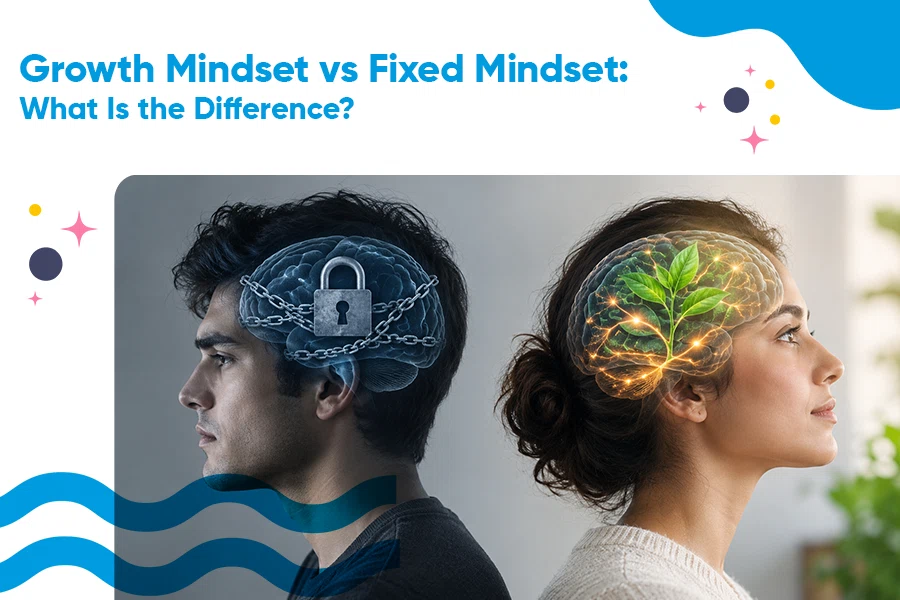
As humans, we are constantly problem-solving. Be it when you’re trying to learn a new skill or solve problems and make decisions with your existing skill-set. Even when we’re learning a new skill, say learning how to drive, for example. You will make tons of mistakes when you’re just starting out. Now, some people might take these mistakes as learning lessons and try to get better, while someone may get completely spooked and just refuse to drive again. There was one problem, and we can observe people solve it in two different ways.
This is what we call Growth mindset vs. Fixed mindset. The main difference between the two isn’t in how intelligent or skilled one is, but it’s more about how an individual accepts their setbacks, minor or major, and responds to them. We’re sure you have seen both these types in your daily life, maybe you might even categorize yourself as one of these.
This theory has been coined fairly recently as opposed to other popular personality theories, but that doesn’t mean it doesn’t hold the same weight. Growth mindset vs. Fixed mindset offers a perspective into how individuals respond to criticism, approach tasks that are unfamiliar to them, and deal with failure. Understanding both ways of thinking is an important part of the work we do, the ways we learn and our relationships with others.
How Did Growth Mindset vs. Fixed Mindset Get Coined?
The phrase traces back to Carol Dweck, a psychologist at Stanford. In her early research, Dweck spent a lot of years studying children and how they responded to difficult or unsolvable puzzles. When a puzzle became difficult, some children actually got excited at the idea of it being harder to solve, while others gave up, being dejected by their failure. She wanted to understand why some children had more mental resilience.
Her 2006 book, Mindset, pulled the research together. The basic claim was that people carry quiet beliefs about whether abilities can change, and those beliefs steer what they do next, often without them noticing.
What Is the Fixed Mindset?
A fixed mindset is the belief that talent is mostly locked in. You’re either smart or not smart, creative or not creative. A fixed mindset is the perspective that traits and talents are pretty unchangeable on a general basis.
In the Growth Mindset vs. Fixed Mindset picture, the fixed side usually gets described first, mostly because it’s easier to spot. Someone leaning that way tends to dodge challenges, because failing feels like a verdict instead of a bad afternoon. Feedback stings more than it should for people who have a fixed mindset. Other people’s success can feel like a small threat, which is a strange thing to feel about a coworker getting promoted, but it happens.
Fixed mindset examples show up everywhere once they get noticed. A teenager skips the school audition because singers are “just born that way.” A manager refuses to learn the new software since tech isn’t really her thing. A runner quits after one slow race and decides the legs are what they are.
What Is the Growth Mindset?
This is where the Growth mindset vs. Fixed mindset gets misunderstood a lot. It isn’t effort versus laziness. Plenty of fixed thinkers work really hard. They just work hard at proving something instead of improving something.
The growth mindset is the belief that abilities can be built, through practice, better strategies, and help from other people. Mistakes turn into information that can be applied in future situations. We have schemas in our heads about the world, any outcome, be it success or failure, can help us update our schemas and be better prepared for future hurdles.
Growth mindset examples are usually pretty ordinary. A student gets a C on a chemistry test and asks the teacher what went wrong instead of hiding the paper. A new coder reads the error message rather than closing the laptop. A nurse in her first month asks a senior colleague to watch her technique and point things out, which feels exposing, and she does it anyway. A growth mindset is about putting yourself out there with the intention to learn something from it.
Related: Creative Thinking Is the Cornerstone of Critical Thinking
Misconceptions Around Growth Mindset vs. Fixed Mindset
Dweck herself has said the idea gets watered down. The classic mistake is praising effort alone. “Great try!” when the strategy clearly isn’t working helps nobody. Sure, it feels better to not berate anyone’s failure, but constructive criticism is required. Real growth thinking includes changing the approach, asking for help, and admitting something is stuck.
Also, nobody is purely one or the other. A person can be wide open to learning in the kitchen and weirdly rigid about public speaking. Mixed is normal. Most individuals are typically mixed in their mindsets honestly.
Growth Mindset vs. Fixed Mindset in Day-to-day Life
Day to day, both mindsets live in tiny moments of self-talk. “I can’t do this” versus “I can’t do this yet.”
At work, a rough performance review is a decent test. The fixed reaction is to get defensive and find somebody to blame. The growth reaction is usually annoyed first, because people are people, and then curious a day or two later. The curiosity part is the one that matters, even if it arrives late.
When you’re problem-solving, cognitive flexibility also comes in. What is cognitive flexibility? You ask. Cognitive flexibility is your brain’s ability to switch between tasks or pivot to another path when one doesn’t work. A person who has higher cognitive flexibility can adjust their strategies in a better way and hold multiple views at the same time. A growth mindset is the belief behind this ability of people. It is hypothesized that people who have a growth mindset are likelier to exhibit cognitive flexibility than those who do. Of course, this is not absolute, and there are all kinds of situations where someone with a growth mindset might still not exhibit flexibility.
Relationships sneak in here too. Someone who believes people can’t change gives up on hard conversations early. Someone who thinks change is possible keeps showing up, sometimes for too long, to be fair.
Parents run into it with kids all the time. Telling a child “you’re so smart” feels kind, but it can teach the kid that being smart is the thing to protect. Praising the process, the odd strategy, and the stubbornness tends to land better. That’s one spot where mindset psychology gets practical fast.
Growth Mindset Is Not The Same As Positive Thinking
A positive mindset gets lumped in here a lot, and it’s not quite the same animal. Growth mindset isn’t really about being cheerful. Positive thinking says everything will be fine. The growth way of seeing things says this is hard, it might stay hard for a while, and here’s what could help.
One is a mood while the other is more like a plan, a loose one.
Self-improvement culture loves this stuff, sometimes a bit too much. Business books call it a success mindset and stick a mountain on the cover. Some schools prefer the term learning mindset, which sounds less like a label and more like something a person is allowed to be in the middle of. Either way, the label matters less than what someone does after the third failed attempt.
Can Someone’s Mindset Actually Change?
Someone can definitely change their mindset and how they approach problems, but bear in mind that this process is on the slower end. Mindset development doesn’t happen in a weekend workshop, and it backslides, usually right when things get stressful.
A few things seem to help. Notice the voice that says, “I’m just bad at this,” and add the word yet and see what happens. Pay attention to what sets off the defensive reaction, because it’s often one specific kind of situation, like being watched or being compared. Ask for feedback while there’s still time to use it. Personal growth involves a lot of vulnerability, which is understandably difficult for most people but is fruitful in the long run.
Mental resilience builds out of this too, a little at a time, from getting knocked down and having a story ready for what comes next. And overcoming challenges rarely feels heroic in the moment. It feels like a Tuesday, slightly irritated, trying a third approach.
Related: Boredom to Novelty: What Your Brain Is Really Chasing
Honestly, the Growth mindset vs. Fixed mindset debate doesn’t need to be won. Most people slide between both all week. The useful part is catching which one is driving at any given moment and, maybe, sometimes, switching seats.
FAQs
1. What is the basic difference between the two mindsets?
One treats abilities as mostly fixed, the other as something that can be built with practice and good strategies.
2. Who came up with the idea of growth and fixed mindsets?
Psychologist Carol Dweck came up with the idea of growth and fixed mindsets at Stanford while she was researching how children problem-solved. She later published her findings and theory in her 2006 book.
3. Can someone have both mindsets?
Yes, and most people do, depending on the topic or the day.
4. Is effort enough to build a growth-oriented outlook?
Not alone. Changing the strategy and asking for help matter just as much.
5. What are some characteristics of a growth mindset?
Someone with a growth mindset embraces challenges, persists despite experiencing setbacks, values putting in effort over having natural talents, is mostly welcoming to feedback, and gets inspired by others’ successes.