


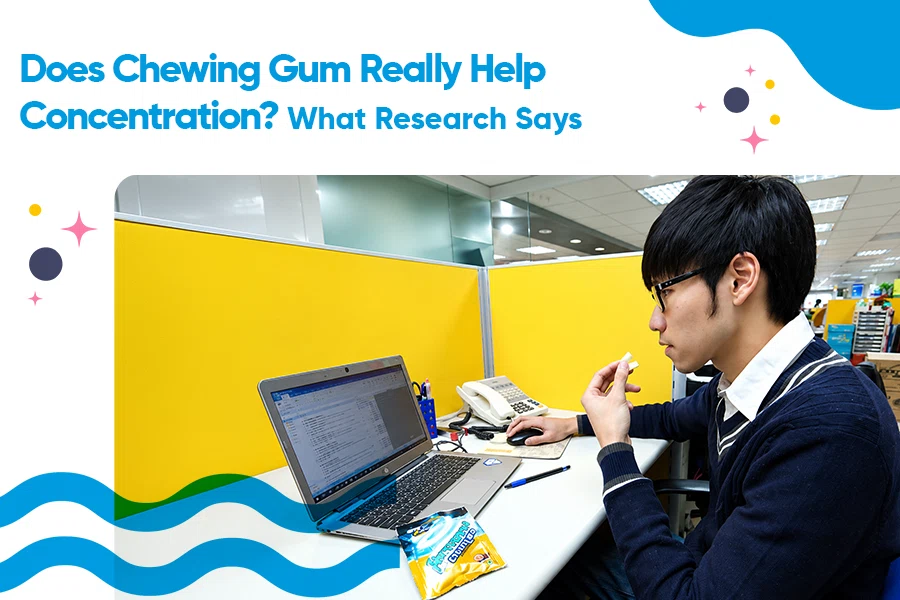
Many people have a habit of chewing gum for enjoyment or for bad breath but they are unaware of the fact that there is so much going behind the scenes. Do you have an idea that there are studies suggesting that chewing gum could help with concentration? Chewing gum has been around for thousands of years in different forms and shapes. Chewing gum can enhance alertness and sustained attention although its effect upon stress may differ spending upon whether chronic or acute stress is examined.
The basic idea researchers keep testing
Most of the studies in this space work off a fairly simple setup. Split people into two groups, one chews gum, one doesn’t, then both do some kind of task: memory recall, attention tests, sustained focus exercises and researchers compare scores. Sounds straightforward. It mostly is, except the results shift depending on what kind of task is being measured and how long the gum-chewing goes on for.
Researchers from Cardiff University underwent a study in which they evaluated the concentration of 38 participants. Each participant was given an audio-based memory task and half of the batch were asked to chew gum throughout the 30 minute test. In the test, the participants were instructed to list numbers being read in random order and were scored based on how quickly and accurately they were able to determine the sequence. They also completed the mood surveys both before and after the exam.
After the study, it was found out that when participants chewed gum throughout the test, they showed better results as they gave quicker answers. Gum chewers did better in the later stretch of the test, the part where attention normally starts slipping. Not at the very beginning. That timing detail matters more than people give it credit for.
Why does the timing matter?
Some research suggests that the boost is strongest early on, within the first twenty minutes or so, and then it fades-possibly because the chewing motion itself becomes a distraction after a while, or maybe people just get used to it and the arousal effect wears off. Other studies, like the one mentioned above, found the opposite pattern, where the gap between chewers and non-chewers widened later into the task.
So which is it? Nobody’s fully sorted that out. It might depend on the kind of task, how repetitive it is, how tired participants already were going in. Chewing gum and attention seems to interact with fatigue somehow, and that’s still being worked through.
The alertness angle
If there’s one thing that shows up again and again across chewing gum cognitive performance research, it’s this: chewing raises alertness. Not focus exactly, not memory exactly: alertness, as its own separate thing. A 2015 study looking at chewing gum across an entire workday found gum use was tied to higher alertness and fewer self-reported “cognitive problems,” plus it seemed to buffer against the usual afternoon dip people get. There has been better productivity and productivity ratings went up too, at least by self-report.
Some researchers have gone as far as scanning brain activity during chewing. One MRI study found more activation in regions tied to the executive network and motor control while people chewed, which lines up with the arousal theory-basically, the physical act of chewing revs up brain activity in a general sense, and that spillover might be what’s helping with attention tasks, rather than gum doing anything special for memory itself.
There’s also an older theory floating around about blood glucose-the idea that chewing increases metabolic activity and glucose availability in the brain, which then supports better cognitive function. It’s a reasonable hypothesis. Whether it’s the main mechanism or just one piece of a bigger picture, that’s honestly still up for debate.
What about actual studying, not just lab tests
Lab tasks are one thing. Real studying is messier, longer, and involves actual comprehension rather than spotting number patterns. A 2019 study tried to bridge that gap-people studied real lesson material, one on physiology, another on a math strategy, while chewing gum or not. Gum chewers scored better on the follow-up tests in both cases. Interestingly, they didn’t report feeling more alert afterward, even though they performed better. Which is a little confusing if you’re expecting alertness to be the explanation every time.
Chewing gum memory effects and gum and attention effects don’t always move together with subjective feelings of focus. Sometimes the performance boost is there even without people noticing anything different about how awake they feel. That disconnect is worth sitting with for a second; it suggests self-report isn’t the whole story here and that something is happening below conscious awareness.
Kids and classrooms
There’s also research done with school-age children, one study with third graders chewing gum during a 16-minute concentration test. Found a meaningful positive effect on concentration performance compared to the non-chewing group. Small sample, young age group, short duration-so it’s not exactly generalizable to, say, an adult prepping for a certification exam. But it does suggest the effect isn’t purely an adult-brain, caffeine-adjacent thing.
Where does the research get shaky?
Not every study agrees, and that’s worth saying plainly instead of glossing over it. Some reviews looking at “cognitive advantages of chewing gum” have basically pointed out that effects show up, then disappear, then show up again depending on study design, sample size, and what exactly counts as “concentration” in that particular experiment. One paper’s title straight up said “now you see them, now you don’t” about these effects, which is a pretty honest way to summarize the field.
Part of the inconsistency probably comes down to how chewing gum concentration is even measured. Reaction time tests, sustained attention tasks, memory recall, real-world study performance; these aren’t interchangeable, and gum might help with some more than others. Lumping them all under “concentration” flattens out differences that actually matter.
Chewing rate and force

A less talked-about variable: how hard or fast someone chews. Some studies specifically varied chewing intensity and found it had limited effects on mood but did shift attention outcomes somewhat. So it’s not just “chew gum, get focus”; the manner of chewing might play a role too, though this hasn’t been explored nearly enough to draw firm conclusions.
Does it actually work or not?
Best answer available right now: Probably yes for certain kinds of attention and alertness tasks, particularly ones that run long enough for normal focus to start dropping off. The benefits of chewing gum for concentration seem real but not huge; this isn’t a cognitive enhancer on the level of, say, caffeine. It’s more of a small nudge. Helpful during a long study session or a slow afternoon at a desk, maybe not going to transform performance on something short and already engaging.
And there’s still the open question of mechanism: arousal, glucose, motor stimulation, some combination of all three that researchers haven’t fully pinned down. A lot of psychology research lives in that space where the effect is documented before the “why” gets fully sorted. One thing that keeps nagging at this whole area of study: most experiments run for 20 to 30 minutes, maybe a workday at most. Nobody’s really tracked what happens over months of habitual gum chewing during work or study-whether the brain adapts, whether the benefit shrinks with repetition, any of that.
FAQs
Does chewing gum improve concentration?
Research suggests a modest improvement, especially during longer tasks, though results aren’t fully consistent across studies.
How long do the benefits of chewing gum last?
Most studies show effects during a single task roughly last between 20 minutes to a few hours; long-term effects aren’t well studied.
Does chewing gum help memory too?
Some studies found better recall and test performance in gum chewers, though the effect size varies.
Why does chewing gum affect focus at all?
The leading theories point to increased alertness, brain arousal from chewing motion, and possibly higher glucose availability.
Is any type of gum better for concentration?
Research hasn’t clearly separated sugar-free from sugared gum effects on cognition, so no specific type stands out yet.