


Most people assume the best way to learn something is to focus on one thing at a time, drill it until it clicks, then move to the next thing. Makes sense on paper. Except it doesn’t actually hold up that well once you look at the data. Interleaving: the practice of mixing different but related skills or topics during a single study session instead of blocking them separately keeps outperforming the “one thing at a time” approach in study after study, even though it feels worse while you’re doing it.
That last part is kind of the whole point, actually. It feels worse. People rate their own learning as slower and messier when they interleave, and then they turn around and perform better on tests days or weeks later. There’s a gap between how learning feels in the moment and how much actually sticks, and interleaving sits right in that gap.
What is Interleaving?
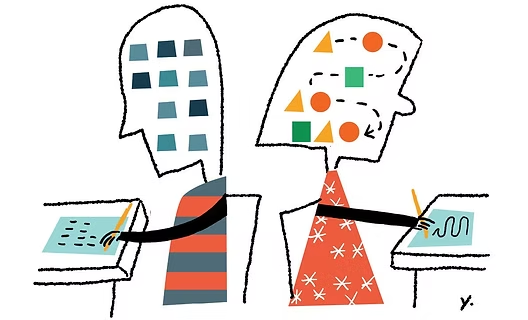
Say someone is learning three types of math problems-let’s call them A, B, and C. Blocked practice would look like AAAA BBBB CCCC. You do all the A problems, get comfortable, then switch. Interleaved practice mixes it up: ABC ACB BCA, that sort of pattern, so you never really settle into a groove. Same total number of problems, same three skills, just shuffled instead of sorted.
This isn’t only a math thing though. Painters practicing different brush techniques in rotation instead of one at a time, baseball players facing mixed pitch types instead of 50 fastballs then 50 curveballs, language learners cycling through vocab categories instead of memorizing one list to death-the same underlying idea keeps popping up across completely unrelated skill sets.
Interleaving isn’t really about mixing random unrelated things together. Doesn’t work if you throw guitar practice and calculus into the same session, at least not for this specific effect. It works when the things being mixed are related enough that your brain actually has to work to tell them apart. That distinguishing part seems to be where the benefit comes from, or at least that’s the leading theory right now.
Why does interleaving work?
There are a few explanations floating around, and honestly researchers don’t fully agree on which one matters most. One idea is that interleaving forces retrieval practice every single time you switch skills: you can’t just coast on momentum, you have to actively pull the right method out of memory each time, which strengthens the retrieval pathway itself. Repetition without that retrieval struggle apparently doesn’t build the same kind of durable memory.
Another explanation, and this one gets cited a lot, is about discrimination. When you block practice, you already know what type of problem you’re solving because you just did nine of the same thing in a row. There’s no decision-making involved. But when problems are mixed, you have to first figure out what kind of problem it is before you can even pick the right approach. That extra step-the “wait, which strategy applies here” moment seems to build a skill that blocked practice just never touches. Some people call this the discriminative-contrast account, though the naming isn’t really important.
There’s also a simpler, almost boring explanation that some studies point to: blocked practice creates an illusion of mastery. You get good at Problem Type A quickly because you’re literally doing the same motion over and over, and that fast improvement feels like real learning. Interleaving denies you that easy feeling of progress, but the actual, durable version of learning that survives a delay seems to be built differently than the quick-feeling kind.
The research isn’t as clean as people like to pretend
A lot of blog content about interleaving makes it sound like a slam dunk, always better, no downsides. That’s not really accurate and it’s worth saying so. Some studies on interleaving show only modest gains, and a few show it doesn’t help much at all for certain types of material, especially things that’s mostly rote memorization with very little conceptual overlap between items. Vocabulary lists, for instance, show mixed results depending on how the study was designed.
There’s also the issue of prior knowledge. Interleaving seems to help more once a learner has some baseline familiarity with the skills being mixed. Total beginners sometimes get overwhelmed by interleaved practice because they don’t have any foundation yet to compare things against-the discrimination process needs something to discriminate between, and if everything’s brand new, that comparison process can just turn into confusion instead of learning.
So it’s not some universal hack. Context matters a lot here, more than most quick-read articles admit.
Mixed practice and the whole “desirable difficulty” thing
This connects to a broader idea in learning science called desirable difficulty. Basically, some kinds of difficulty during learning are annoying in the short term but useful in the long term, because they force deeper processing. Interleaving fits into this bucket alongside retrieval practice and spaced repetition. All three of these techniques share a similar signature: they make learning feel harder and slower while it’s happening, and they all tend to produce better long-term retention than the smoother-feeling alternatives.
Active recall works similarly-testing yourself instead of rereading notes feels uncomfortable because you might get it wrong, but that discomfort is doing something useful in the background. Interleaving just adds another layer of difficulty on top by also making you figure out which knowledge to retrieve in the first place.
Related: Biohacking for Better Productivity: Science-Backed Habits That Actually Work
What this looks like for studying
For someone studying, say, three chapters of a stats course, interleaving might mean instead of finishing all the practice problems for Chapter 4 before moving to Chapter 5, you’d do a handful from 4, a handful from 5, a couple old ones from Chapter 3 thrown back in, then loop again. Annoying to set up. Takes more planning than just working through a textbook front to back. Most people don’t bother, honestly, because blocked practice is just easier to organize and feels more productive minute to minute.
Interleaving also seems to matter for skill development more broadly, not just academic content. Musicians switching between scales, chord progressions, and sight-reading in one practice session instead of dedicating entire days to just one some teachers swear by this, others still prefer old-school blocked drilling for beginners specifically, which loops back to that prior-knowledge point from earlier.
A quick tangent on memory retention
Memory retention research keeps circling back to this same theme that struggle during encoding predicts durability later. It’s not really about how smooth the learning feels, it’s about how much cognitive work is happening under the hood. Interleaving cranks up that work. Whether that’s always worth the frustration probably depends on the goal. Cramming for a test tomorrow? Blocked practice might actually be fine, maybe even better short-term. Trying to retain something for months or build a transferable skill? That’s where interleaved and mixed practice tend to pull ahead.
It’s a trade-off between how learning feels and how learning performs, and those two things aren’t the same measurement even though people constantly treat them like they are.
Related: How to Improve Memory and Recall in Everyday Life
Is it worth doing?
For most learners tackling related skills over a longer timeframe. Not a magic fix, and definitely not something that replaces basic study habits like spacing sessions out or actually testing yourself. But as one piece among several learning strategies, interleaving keeps earning its spot in the research because the long-term data, messy as it sometimes is, tends to favor it over pure blocked repetition.
FAQs
1. Is interleaving the same as multitasking?
No. Interleaving means switching between related skills one at a time, not doing them simultaneously.
2. Does interleaving work for complete beginners?
Not always; some baseline familiarity with the material usually helps it work better.
3. Why does interleaved practice feel harder than blocked practice?
Because you have to figure out which skill or strategy applies each time, instead of just repeating one thing.
4. Can interleaving be combined with spaced repetition?
Yes, and many learning strategies pair the two together for stronger long-term retention.
5. Is interleaving better for short-term or long-term learning?
It tends to help more with long-term retention; blocked practice can sometimes work fine for short-term cramming.